
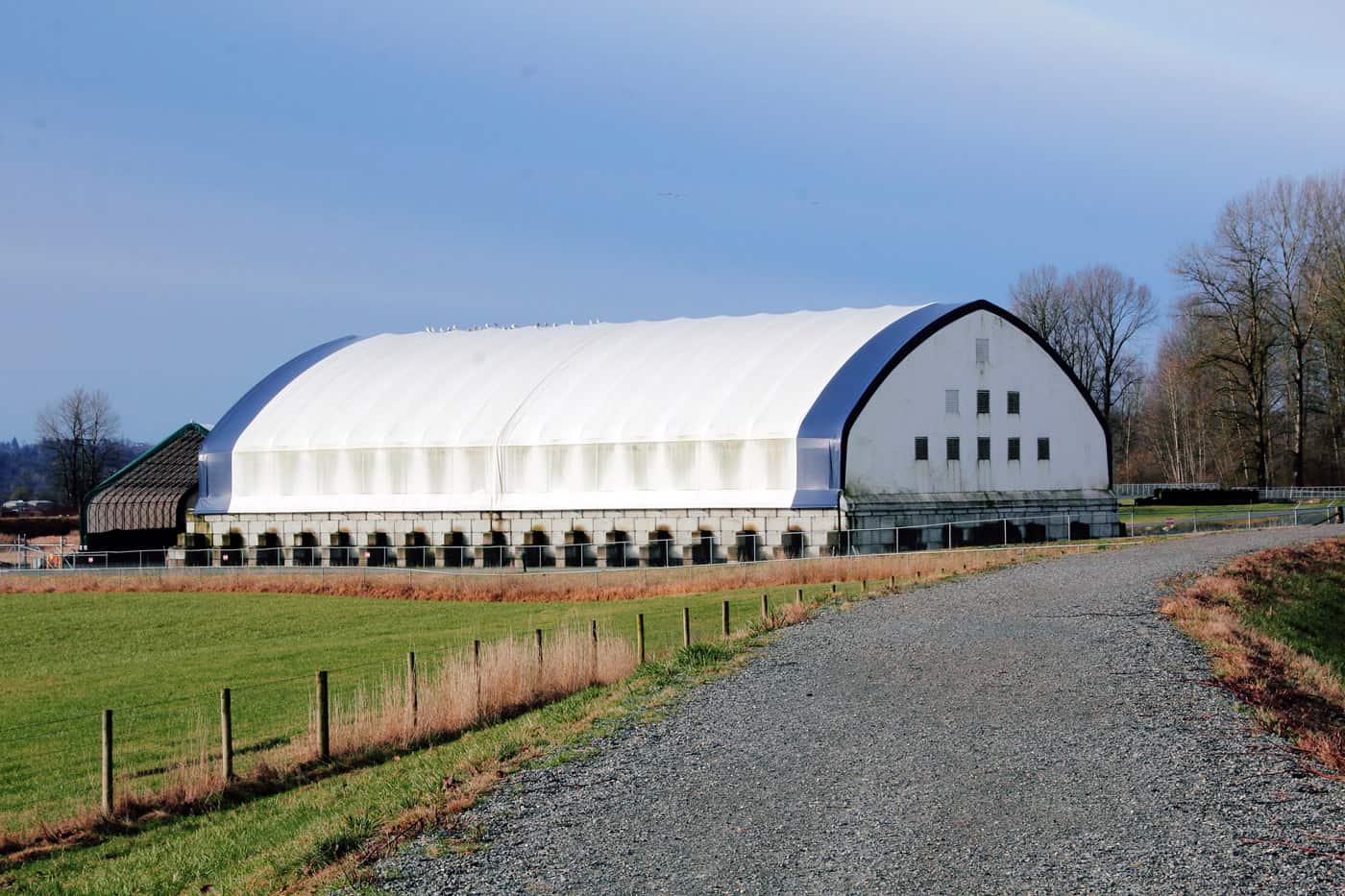
If you’re looking for an affordable, easy-to-build metal structure, a hoop building may be an excellent option for you. Their rounded design makes them similar to a Quonset hut, but rather than being an all-metal structure, hoop buildings use fabric to cover and protect the interior.
Hoop buildings have many advantages, and they are generally less expensive to construct than other building types. Let’s take a closer look at what these buildings are, how they are used and how much they cost.
Quick answer: Hoop building kits run roughly $3.50 to $10 per square foot depending on span, length, and build grade. A budget 30′ × 100′ lands near $17,750; a mid-grade branded 34′ × 40′ runs about $8,805. Longer buildings cost less per square foot; wider ones cost more. Get your exact price.
What are Hoop Buildings?

Hoop buildings are a type of fabric tension building, sometimes called a tensile structure. A typical hoop building comprises a heavy-duty metal frame with a UV-resistant fabric covering stretched tightly over it. The fabric is usually canvas, high-density polyethylene, or another heavy-duty material.
As the name indicates, the building features a hooped roof. Because there are relatively few components, they’re often portable and suit a wide range of applications. Structurally, they’re close cousins of the Quonset hut.
Hoop building vs. Quonset hut: the difference is what carries the load. A hoop building uses a steel tube frame with a tensioned fabric cover — the frame is the structure and the cover is a consumable, typically replaced every 15 to 20 years. A Quonset hut is built from structural corrugated steel panels, where the arch itself is the structure. The Quonset lasts longer; the hoop building is cheaper, faster to erect, and easier to relocate.
What are Hoop Barns Used For?
Hoop buildings serve various purposes, from agricultural to storage and industrial applications.
Agricultural operations favor hoop buildings for livestock because of superior air circulation. Adequate ventilation is critical for animal health, and the rounded, hooped design promotes good airflow while the translucent cover admits natural daylight. Structures are available for specific livestock types including cattle, sheep, and swine. Dairy buildings are another popular application.
Hoop barns can also be used to store feed, agricultural equipment, and other related items.
While agriculture dominates, they also function as storage facilities. Storage Canopy offers hoop structures designed as roofs, providing coverage between shipping containers or other storage facilities for easier access.
Additional uses include:
- Hay storage
- Riding arenas
- Farm garages
- Construction shelter
- Commodity sheds
- Sand or salt sheds
Related structures on our site: Storage Unit Buildings, Sports Facilities, Metal Gyms, Greenhouses, Hobby Garage, Barndominiums, Shop Houses, RV Garage, Breweries, and Farm Structures.
Hoop Buildings Prices
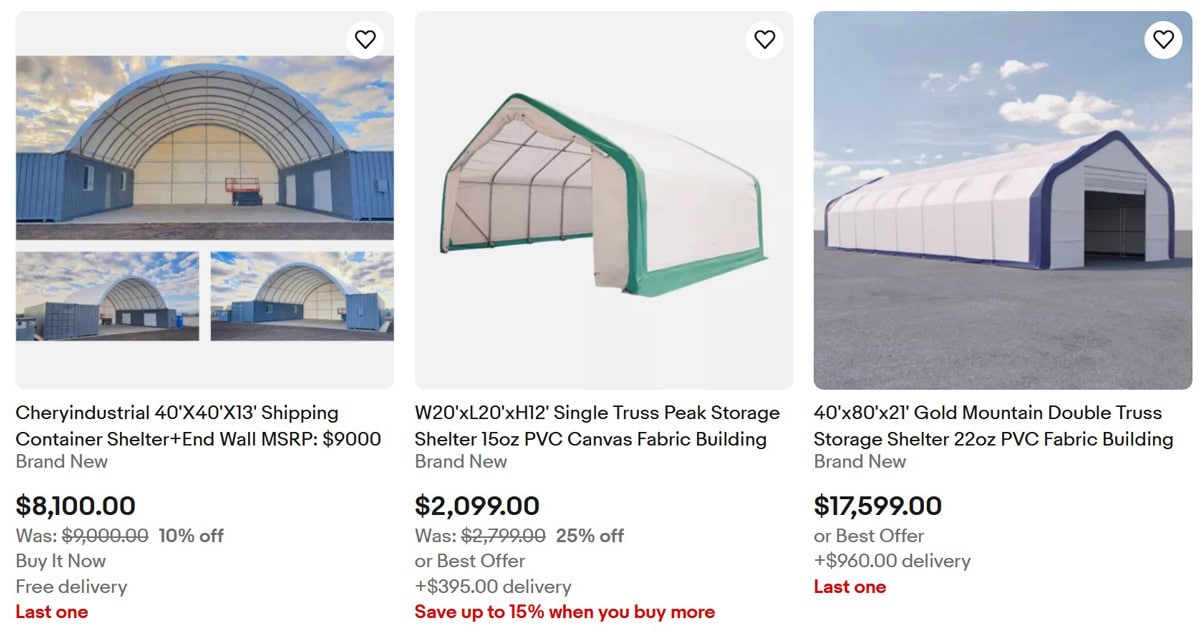
Hoop buildings attract homeowners and businesses for storage, livestock, farming, multi-use, and farm garages. Width has the single biggest impact on price per square foot, with buildings available roughly between 24′ and 140′ wide.
Starting prices, kit only:
- $3.43 per square foot — single truss models
- $4.81 per square foot — double truss models
Two important caveats on those figures. First, they’re starting rates that apply to the longest buildings in each line — a 100′-plus building spreads its fixed end-wall cost over far more floor area. Shorter buildings of the same width run considerably higher per square foot, as the tables below show. Second, they’re basic kit prices only, with no foundation, installation, or enclosure.
Attaching a hoop structure to shipping containers — a common approach — adds significantly to the total. A 40-foot container alone ranges from $4,000 up to $8,500 or more.
Two rules that drive hoop building pricing
1. Longer buildings cost less per square foot. End walls are a fixed cost. Stretch the same building longer and that cost spreads across more floor area. Holding width constant, going from a short to a long model drops the per-square-foot rate by 11% to 40% depending on the line.
2. Wider buildings cost more per square foot — and this outweighs total size. Span drives truss weight, so a wider building costs more per foot even though it’s a bigger building. At an identical 40′ length, a 34′-wide unit runs about $6.47/sq ft while a 42′-wide unit runs $8.29/sq ft — 28% more per square foot for the wider span.
What this means practically: if your layout allows it, going longer is far cheaper than going wider. A 34′ × 60′ will cost meaningfully less per square foot than a 42′ × 48′ covering similar area.
Hoop building price tiers
“Hoop building” covers three fairly different products, which is why published prices range so widely:
| Grade | What it is | Kit only | Installed |
|---|---|---|---|
| Light-duty shelter | Light tube frame, poly or light fabric, often no permanent foundation | $3.50–$6/sq ft | $6–$12/sq ft |
| Mid-grade / agricultural | Steel tube trusses, UV-resistant cover, post or pier anchored — the most common choice | $6–$8.50/sq ft | $10–$15/sq ft |
| Engineered commercial | Heavy truss or I-beam frame, engineered to local wind and snow code, permanent foundation, 20–30+ year design life | $15–$26/sq ft | $23–$38/sq ft |
Most farm and storage buyers land in the mid-grade tier. Municipal, salt-storage, and large commercial projects generally require the engineered tier to satisfy code.
Single Truss Building Prices by Width
Hoop Buildings LLC single truss leg unit pricing examples:
| Width | Shortest model | Longest model |
|---|---|---|
| 20′ | 15′ long — $3,000 | 100′ long — $12,700 |
| 24′ | 24′ long — $3,400 | 102′ long — $9,400 |
| 25′ | 15′ long — $3,400 | 100′ long — $12,650 |
| 30′ | 24′ long — $4,000 | 102′ long — $11,500 |
| 30′ | 16′ long — $4,400 | 100′ long — $17,750 |
| 35′ | 15′ long — $3,900 | 100′ long — $15,400 |
Sheltervision offers models from 10′ to 45’+ wide. Comparable sizes include a 20′ × 20′ storage building at $3,095 and a 30′ × 30′ hoop shelter at $4,895.
Mid-Grade Building Prices by Size
The prices above reflect budget-line structures. For comparison, here are current retail prices on mid-grade branded fabric buildings — useful as the benchmark to measure any quote against:
| Size | Sq ft | Kit price | Per sq ft |
|---|---|---|---|
| 20’W × 20’L | 400 | $3,275 | $8.19 |
| 20’W × 36’L | 720 | $5,245 | $7.28 |
| 26’W × 24’L | 624 | $4,949 | $7.93 |
| 26’W × 48’L | 1,248 | $7,439 | $5.96 |
| 34’W × 40’L | 1,360 | $8,805 | $6.47 |
| 42’W × 40’L | 1,680 | $13,925 | $8.29 |
| 42’W × 60’L | 2,520 | $19,495 | $7.74 |
| 38’W × 80’L | 3,040 | $19,015 | $6.25 |
Fully enclosed units cost significantly more than open or partially open structures. Because span and snow load move these prices more than almost any other variable, manufacturers quote custom rather than publishing fixed pricing. Get a free, no-obligation quote for your exact configuration.
7 Considerations For Fabric Hoop Buildings Design
Land Clearing
Many hoop buildings install quickly, but depending on your site and intended use you may need to budget for removing brush and trees, and grading or excavating the land.
Land clearing is a major cost consideration and is best addressed through discussions with local contractors before you finalize a building budget.
Foundation Options
Hoop buildings may or may not require a foundation, which is a large part of why they cost less than permanent steel structures. Potential options include precast concrete, I-beams, L-panels, T-panels, and cast-in-place concrete.
Intended use determines necessity. A slab or continuous footing becomes worthwhile for permanent installations, heavy equipment traffic, or anywhere you need a washable floor. See our full comparison of foundation options.
Building Guarantees
Multiple types of guarantee exist when purchasing:
- Full guarantees — often three years or less, covering the entire structure
- Truss building guarantees
- Mono-tube building guarantees
Guarantees provide assurance that the structure you purchase and erect will be covered in the event of a defect or other issue. Note that frame and cover are frequently warranted separately and for different terms — worth confirming before you buy, since the cover is the shorter-lived component.
Color Options
Most models come in black or white, though manufacturers increasingly offer red, yellow, grey, and blue. Customization may be available on request.
Cover color affects more than appearance: lighter covers transmit more daylight into the building, which matters for livestock housing and for anywhere you’d otherwise need daytime lighting.
Cover Material
Cover materials vary, with considerations including UV resistance, fire-proof options, and fabric density.
UV resistance matters significantly for full-sun installations, where sunlight fades the covering color and degrades the fabric over time. Cover weight and UV rating are the main determinants of how long you go before re-covering — typically 15 to 20 years for a quality cover.
Structure Size
Start with two questions: how much space do you need, and what is the intended purpose? Those answers determine the appropriate building. Your available property must also accommodate the structure plus clearance for access and drainage.
Keep the two pricing rules above in mind at this stage — sizing longer rather than wider is usually the cheaper path to the same square footage.
Roof and Leg Design
While all hoop buildings are rounded, profile options include low slope, gable roof, LA profile, and standard profile.
The right choice depends on intended use. Low-slope buildings may prove unsuitable for livestock or large equipment without taller foundations. A 10′ leg profile suits machinery and equipment storage, offering maximum height and clearance along the building’s sides.
Final Thoughts
Hoop buildings provide practical solutions for livestock, storage, and many other purposes. They go up quickly and cost less than most alternatives. Let the design considerations above guide your selection — particularly span, cover grade, and whether you need a foundation, since those three drive most of the price difference between quotes.
Shop The Sale or get your free, no-obligation quote.
Hoop Building FAQ
How much does a hoop building cost?
Hoop building kits run roughly $3.50 to $10 per square foot depending on span, length, and build grade. Budget single-truss lines start near $3.43/sq ft on the longest models, mid-grade branded buildings run about $6 to $8.50/sq ft, and engineered commercial structures run $15 to $26/sq ft. Installation typically adds $2 to $5 per square foot on top of the kit.
How much does a 40×60 hoop building cost?
A 40′ × 60′ gives you 2,400 square feet. At mid-grade rates that works out to roughly $15,000 to $19,000 for the kit, based on current pricing for comparable 38′ to 42′-wide buildings. Wider spans carry a premium per square foot, so a 40′-wide building costs more per foot than a 30′-wide one of the same length. Get a quote for a 40×60.
Are used hoop buildings worth buying?
Sometimes — but inspect the cover first. The fabric is the wear item and typically needs replacing every 15 to 20 years, and a replacement cover on a large building can approach a meaningful fraction of a new structure’s cost. Check for UV chalking, seam separation, and loss of tension. The steel frame underneath, if it hasn’t rusted at the ground contact points, generally outlasts several covers.
How long does the fabric cover last?
Most quality UV-resistant covers last 15 to 20 years before replacement. Cover weight, local UV exposure, and how well the fabric is kept tensioned all affect that. The frame typically outlasts the cover by decades, which is why re-covering an existing frame is usually far cheaper than replacing the whole building.
Are hoop buildings good for cattle and livestock?
They’re one of the most common livestock housing choices, and the reason is airflow. The translucent cover admits natural daylight while the open profile and ridge design promote passive ventilation, reducing respiratory issues and moisture buildup compared with enclosed metal barns. The absence of interior columns also means no obstructions for equipment or animal movement.
Do hoop buildings need a foundation?
Not always, which is part of the appeal. Many are anchored to posts, driven piers, or concrete blocks rather than a full slab, cutting both cost and lead time. A slab or continuous footing becomes worthwhile for permanent installations, heavy equipment traffic, or anywhere you need a washable floor. See foundation options.
What’s the difference between a hoop building and a Quonset hut?
A hoop building uses a steel tube frame with a tensioned fabric cover. A Quonset hut is built from structural corrugated steel panels, where the arch itself is the structure. The Quonset is a permanent building with a longer lifespan; the hoop building is cheaper, faster to erect, and easier to relocate, but the cover is a consumable.
Do I need a permit for a hoop building?
Usually, though requirements vary more than for permanent steel buildings. Some jurisdictions classify fabric structures as temporary or agricultural and apply lighter rules; others treat them identically to any other building. Agricultural exemptions are common but not universal. Check your state page before ordering.